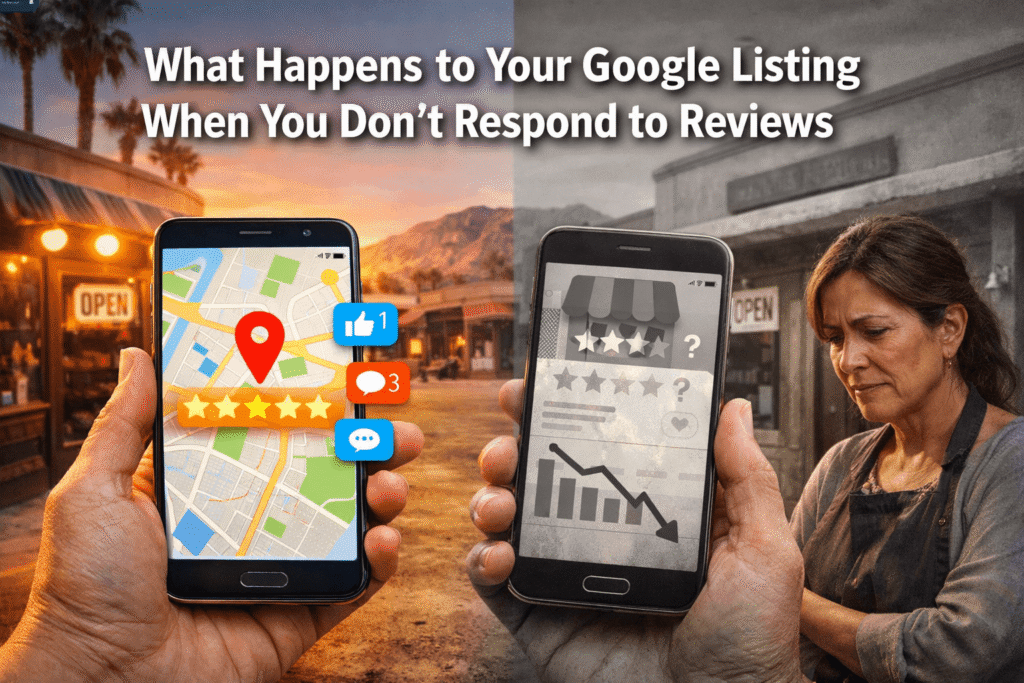
What Happens to Your Google Listing When You Don’t Respond to Reviews
Quick Answer
When you don’t respond to Google reviews, your business listing slowly becomes invisible to potential customers searching in your area. Google interprets silence as a signal that your business is inactive or unresponsive, which directly lowers your ranking in local search results and Google Maps. Meanwhile, customers who see unanswered reviews, especially negative ones, assume you don’t care about their experience and choose your competitors instead.
Key Takeaways
- Google penalizes inactive profiles: Businesses that don’t respond to reviews rank lower in local search results because Google views responses as engagement signals that indicate an active, trustworthy business.
- Your competitors move ahead: When you ignore reviews, businesses that do respond to Google reviews consistently will outrank you in Maps and local search, even if their ratings are similar to yours.
- Revenue impact is measurable: Companies responding to all reviews see up to 18% higher revenue, and 89% of consumers prefer businesses that reply to reviews.[2]
- Negative reviews compound damage: An unanswered negative review stays at the top of your profile and influences potential customers for months or years, while a thoughtful response can turn criticism into trust.
- Profile decay accelerates without activity: Businesses that haven’t posted updates, photos, or review responses in over 30 days experience faster visibility decline than in previous years.[3]
- Simple responses make a difference: Even brief, personalized replies signal to Google and customers that your business is active and cares about feedback.
- It’s not too late to start: You can begin responding today and start rebuilding your ranking and reputation immediately.
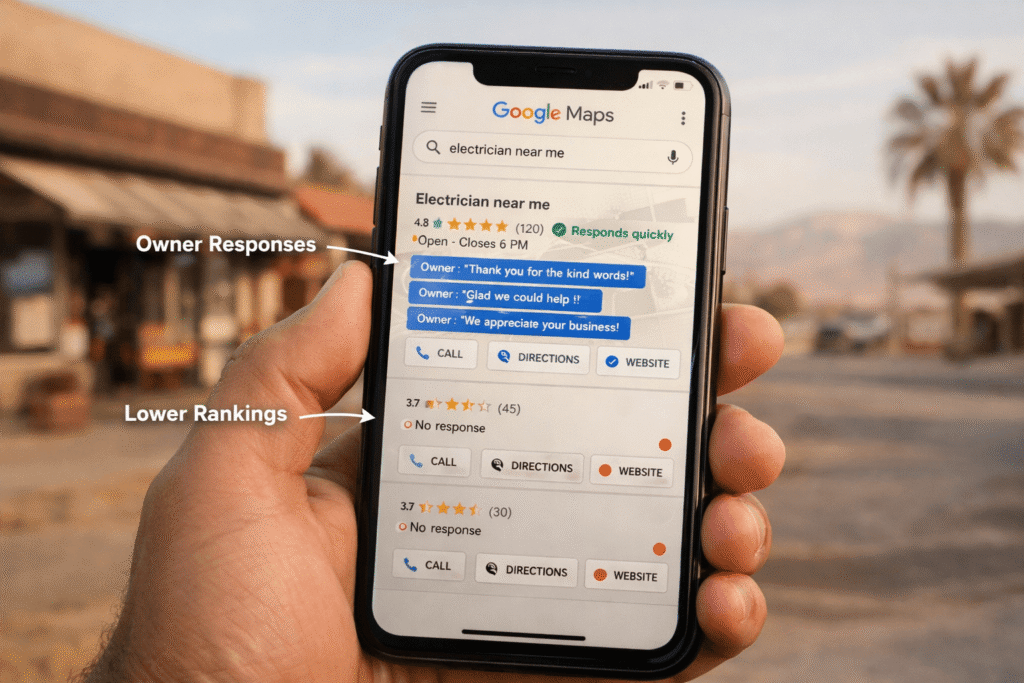
How Does Ignoring Reviews Affect Your Google Maps Ranking?
When you don’t respond to Google reviews, your business drops in local search rankings because Google’s algorithm treats review responses as trust and engagement signals. Businesses that actively reply to reviews signal to Google that they’re responsive, relevant, and worth showing to searchers.
Here’s what happens behind the scenes:
Google measures engagement activity. Every time you respond to a review, Google registers it as a positive engagement signal. These signals tell the algorithm that your business is active and cares about customer feedback. Businesses with consistent response patterns rank higher in Maps and local search results.[1]
Your competitors gain the advantage. If an electrician in El Centro responds to every review and you don’t, Google will favor their listing over yours, even if your star rating is identical. The algorithm prioritizes businesses that demonstrate responsiveness because that’s what searchers want to see.
Ranking factors have shifted in 2026. Behavioral signals like profile views, clicks, calls, and review responses now outweigh traditional keyword placement. High engagement indicates real-world relevance, and Google rewards it with better visibility.[4]
Reviews account for approximately 10% of local ranking factors, with review velocity (how frequently you receive new reviews) signaling business relevance to Google.[2] But it’s not just about getting reviews. It’s about what you do with them.
What Signals Does Google Look For?
Google doesn’t just count responses. The algorithm evaluates:
- Response timing: Faster replies signal active management
- Response quality: Personalized, contextual replies carry more weight than generic templates
- Consistency: Regular response patterns indicate ongoing engagement
- Sentiment alignment: Thoughtful replies to negative reviews demonstrate professionalism
Important note: As of 2026, owner responses are now reviewed by Google before publication to ensure compliance with content rules. Delays are often up to 10 minutes but sometimes up to 30 days, which can slow your engagement signal transmission.[3]
If you’re not managing your Google Business Profile actively, you’re essentially telling Google your business isn’t worth promoting.
Why Do Customers Care If You Respond to Google Reviews?
Customers view unanswered reviews as a red flag that signals neglect, indifference, or even that your business might be closed. When potential customers in Imperial Valley search for a contractor, clinic, or shop and see reviews with no responses, they assume you won’t respond to them either.
Trust is built through visibility. When someone reads a review, positive or negative, and sees a thoughtful owner response, it demonstrates accountability. It shows you’re listening, you care, and you’re willing to address concerns. That builds confidence before they ever pick up the phone.
Negative reviews become permanent damage. An unanswered 1-star review sits at the top of your profile and influences every potential customer who sees it. But a professional, empathetic response can completely change the narrative. It shows you take feedback seriously and work to make things right.
Real-World Example: Two Contractors in the Imperial Valley
Consider two concrete contractors serving the same Imperial Valley market, both with similar services and pricing.
Contractor A has 20 reviews with zero responses. The most recent negative review from two months ago complains about a missed appointment and is still sitting there, unanswered.
Contractor B has 18 reviews and responds to every single one within a few days. Even the critical feedback gets a thoughtful reply: “We’re sorry about the scheduling issue. That’s not how we operate. Please call us directly so we can make it right.”
Which one would you call?
89% of consumers prefer businesses that reply to their reviews.[2] That preference directly translates into phone calls, appointment requests, and revenue. When you respond to reviews, you’re not just talking to the reviewer. You’re talking to everyone who reads your profile afterward.
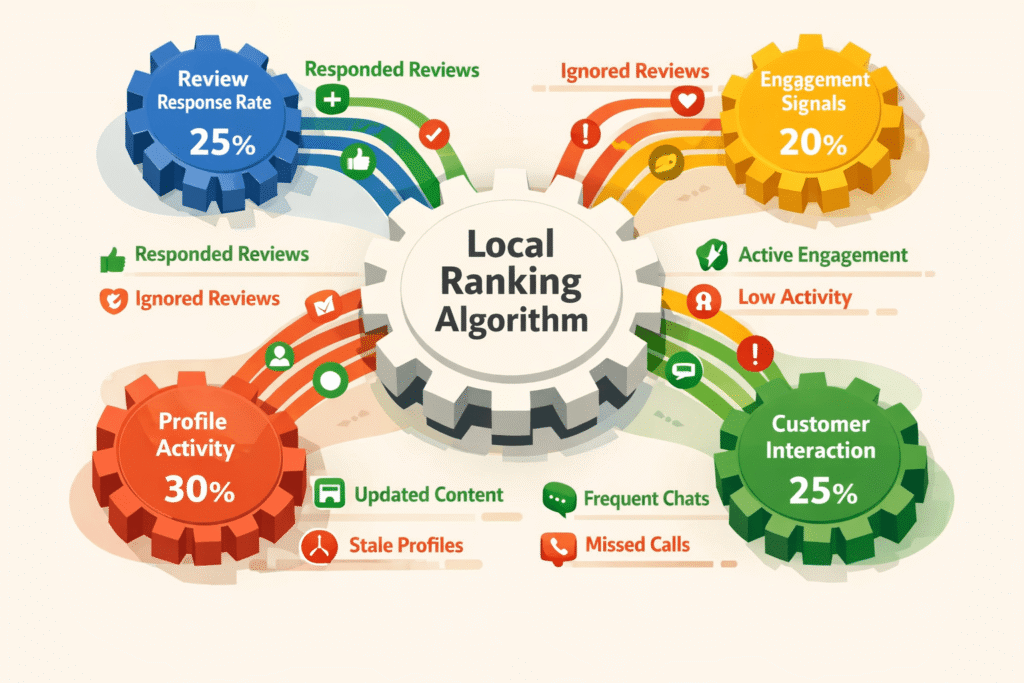
What Happens to Your Visibility When You Don’t Respond to Google Reviews?
Your Google listing becomes less visible over time, which means fewer people see your business when they search for services you offer. Google’s algorithm interprets inactivity as irrelevance, and your ranking gradually declines in favor of competitors who actively manage their profiles.
Profile freshness decay accelerates without regular activity. A dramatic visibility decrease occurs for businesses that haven’t posted an update, photo, or review response in over 30 days. Inactive profiles experience faster ranking decay than in previous years.[3]
Think of your Google listing like a storefront. If the lights are off, the door looks locked, and nobody’s answering the phone, people walk past. That’s what happens digitally when you ignore reviews.
How Visibility Decline Impacts Your Business
Fewer people see your listing. When you drop from position 2 to position 6 in local search results, your visibility decreases dramatically. Most searchers never scroll past the top three results.
Competitors capture your customers. Every potential customer who doesn’t see your listing is a customer your competitor gains. In Imperial Valley’s tight-knit business community, that matters.
Your phone stops ringing. Reduced visibility means fewer profile views, fewer clicks to your website, and fewer calls. The impact compounds over weeks and months.
What an Active Profile Looks Like in Practice
Here in the Imperial Valley, we’ve seen exactly what happens when a Google Business Profile is built right and actively managed from day one.
Valley Concrete came to us with no website, no Google Business Profile, and zero online presence. They were completely invisible to anyone searching for concrete services in the area. We built their profile from scratch, optimized everything, and kept engagement consistent from day one.
| Metric | Result |
|---|---|
| Profile Views | 1,895 |
| Direct Phone Calls | 36 |
| Search Appearances | 556 |
| Ad Spend | $0 |
Every one of those calls came from organic search and an active, well-managed profile.
Premier Electrical Contractors had a similar starting point with no Google Business Profile at all. After building and optimizing their profile alongside a new website, the results came quickly.
| Metric | Result |
|---|---|
| Direct Phone Calls | 16 |
| Profile Views | 568 |
| Website Clicks from GBP | 42 |
| Contact Page Views (first 30 days) | 2 → 37 (+1,750%) |
Neither of these results would have been possible without active, consistent profile management. An ignored profile doesn’t just underperform. It disappears.
Complete Profiles Get 7x More Engagement
Businesses with complete and accurate Google Business Profile information are 2.7 times more likely to be considered reputable and receive 7 times more clicks compared to those with missing information.[1] Review responses are part of that completeness signal.
If you’re not actively managing your profile, including responding to reviews, you’re leaving visibility and revenue on the table.
For help optimizing your local map listing, reach out to a local expert who understands Imperial Valley businesses.
Can Unanswered Negative Reviews Hurt Your Business Long-Term?
Yes. Unanswered negative reviews create lasting damage that compounds over time because they remain permanently visible, influence every future customer who reads them, and signal to Google that your business doesn’t engage with feedback.
Negative reviews don’t disappear. That 1-star review from six months ago is still one of the first things potential customers see. Without a response, it stands as the final word on that customer’s experience.
They shape perception for months or years. Every person who searches for your business and reads that unanswered complaint forms an opinion based on your silence. Over time, that’s hundreds or thousands of potential customers who decide to call someone else.
Google interprets silence as disengagement. The algorithm doesn’t just count stars. It evaluates how you handle feedback. Businesses that respond to negative reviews demonstrate accountability, which Google rewards with better visibility.[1]
What a Response Can Do
A thoughtful reply to a negative review can:
- Neutralize the damage by showing your side of the story
- Demonstrate professionalism to every future customer who reads the thread
- Turn a detractor into a repeat customer if you resolve the issue
- Signal to Google that you’re actively managing your reputation
Example response to a negative review:
“We’re sorry to hear about your experience, and we’d like to make this right. Please give us a call at (760) 555-1234 so we can address this directly. We appreciate your feedback and take it seriously.”
That’s 35 words that can save your reputation and keep customers from walking away.
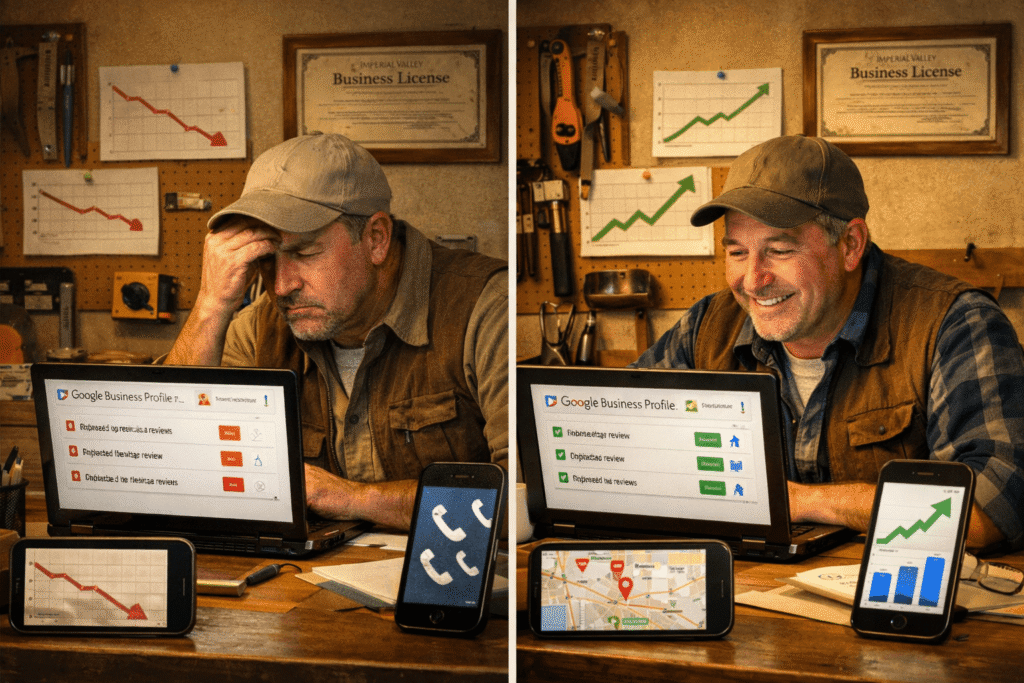
How Quickly Does Your Ranking Drop If You Stop Responding to Reviews?
Your ranking doesn’t collapse overnight, but visibility decline begins within 30 to 60 days of inactivity and accelerates if competitors in your area are actively managing their profiles. The speed of decline depends on how competitive your industry is in Imperial Valley and how engaged your competitors are.
Initial impact within 30 to 60 days. Google’s algorithm continuously evaluates engagement signals. If you stop responding to reviews while competitors continue, you’ll start seeing ranking shifts within the first month or two.
Accelerated decay after 90 days. After three months of inactivity, the decline becomes more noticeable. Businesses that haven’t posted updates, photos, or review responses in over 30 days experience faster ranking decay.[3]
Competitive markets feel it faster. If you’re an electrician in El Centro competing against five other electricians who all actively respond to reviews, your decline will be faster than if you’re in a less contested category.
What Slows or Speeds Up the Decline?
Factors that accelerate ranking loss:
- High competition in your service category
- Competitors actively responding to reviews
- New negative reviews that go unanswered
- No other profile activity (posts, photos, updates)
Factors that slow ranking loss:
- Strong existing review base with high ratings
- Consistent website traffic and engagement
- Other active signals (regular posts, photos, Q&A responses)
The good news? You can reverse the decline by starting to respond to Google reviews consistently. The algorithm rewards renewed activity.
What Should You Do If You Haven’t Been Responding to Reviews?
Start responding today, even to old reviews, and establish a consistent response routine moving forward. Google rewards renewed engagement, and customers appreciate seeing that you’re now actively managing your reputation.
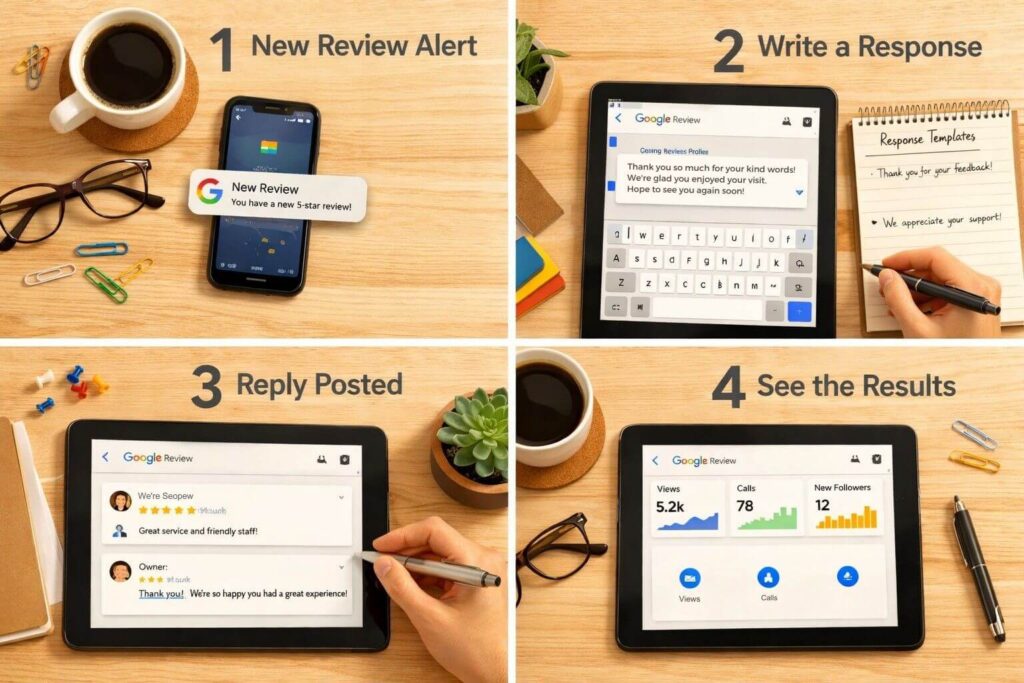
Step 1: Respond to recent reviews first. Focus on reviews from the last 30 to 60 days, starting with any negative or neutral feedback. A thoughtful response can still make a difference even weeks later.
Step 2: Work backward through older reviews. You don’t need to respond to every review from the past three years in one day, but gradually working through them signals renewed activity to Google.
Step 3: Set up a response routine. Check your Google Business Profile at least once a week. Respond to new reviews within 3 to 7 days. Consistency matters more than speed.
Step 4: Personalize every response. Avoid templates. Mention specific details from the review to show you actually read it. Even simple replies like “Thanks for choosing us for your electrical work, Maria! We’re glad we could help with your panel upgrade” make a difference.
Step 5: Address negative reviews professionally. Acknowledge the issue, apologize if appropriate, and offer to resolve it offline. Never argue or get defensive in public responses.
Response Template Framework (Customize These)
For positive reviews: “Thanks for the kind words, [Name]! We’re glad we could help with [specific service]. We appreciate your business and hope to work with you again.”
For negative reviews: “We’re sorry to hear about your experience with [specific issue]. This isn’t the standard we hold ourselves to. Please call us at [phone] so we can make this right.”
For neutral reviews: “Thanks for your feedback, [Name]. We’re always looking to improve, and we appreciate you taking the time to share your experience.”
If managing reviews feels overwhelming, consider working with a local digital marketing agency that understands Imperial Valley businesses and can handle responses for you.
How Do Review Responses Compare to Other Ranking Factors?
Review responses are one piece of a larger engagement puzzle, but they’re increasingly important in 2026 because Google now prioritizes behavioral signals over traditional keyword optimization. While responses alone won’t fix a poorly optimized profile, they’re essential for maintaining competitive rankings.
Reviews account for approximately 10% of local ranking factors, with response activity contributing to that weight.[2] But the real power comes from how responses combine with other signals.
Ranking Factor Breakdown (2026)
| Ranking Factor | Estimated Impact | What It Means |
|---|---|---|
| Behavioral Signals | 25-30% | Profile views, clicks, calls, direction requests, messages |
| Google Business Profile Completeness | 20-25% | Accurate info, categories, hours, photos, posts, review responses |
| Reviews & Ratings | 10-15% | Star rating, review quantity, recency, response rate, sentiment |
| Website Authority | 15-20% | Domain authority, content quality, local keyword integration, technical SEO |
| Proximity & Relevance | 20-25% | Distance from searcher, service area accuracy, category match |
Key insight: Behavioral signals now outweigh keyword placement.[4] User engagement actions like calls, website clicks, and driving directions indicate real-world relevance and strongly influence rankings.
Why Responses Amplify Other Signals
When you respond to reviews:
- You increase profile engagement (a behavioral signal)
- You demonstrate active management (a completeness signal)
- You encourage more reviews (a review velocity signal)
- You build trust that leads to clicks and calls (more behavioral signals)
It’s not just about the response itself. It’s about the ripple effect it creates across every other signal Google is tracking.
For a complete approach to local SEO, responses should be part of a broader strategy that includes profile optimization, regular posts, and website integration.
Common Mistakes When You Finally Start Responding to Google Reviews
Using the same template for every review. Google’s systems now identify unnatural behavior patterns, and templated review responses no longer carry the same weight they did previously.[4] Personalize every reply with specific details from the review.
Responding too defensively to negative reviews. Arguing with a customer in public makes you look unprofessional to everyone reading your profile. Acknowledge the issue, apologize if appropriate, and move the conversation offline.
Ignoring 3-star reviews. Neutral reviews are opportunities to turn lukewarm customers into advocates. A thoughtful response can shift their perception and encourage them to update their review.
Waiting weeks to respond. While any response is better than none, timely replies within 3 to 7 days signal active management to both Google and customers.
Forgetting to thank positive reviewers. Every 5-star review deserves acknowledgment. It takes 10 seconds and reinforces customer loyalty.
Focusing only on new reviews. Working backward through older unanswered reviews signals renewed engagement to Google and shows customers you’re now actively managing your reputation.
Not monitoring competitor responses. See how other businesses in your category respond to reviews. Learn from what works and avoid what doesn’t.
FAQ
How long does it take to see ranking improvements after I start responding to reviews?
You’ll typically see initial ranking improvements within 30 to 60 days of consistent review response activity, though the exact timeline depends on your competition level and overall profile health. Google needs time to register the engagement signals and adjust your ranking accordingly.
Do I need to respond to every single review?
While responding to all reviews is ideal, prioritize negative and neutral reviews first, then work on thanking positive reviewers. Consistency matters more than perfection. Aim for at least an 80% response rate to show active engagement.
Can I delete negative reviews instead of responding to them?
You can only flag reviews that violate Google’s policies (spam, fake, offensive content). Legitimate negative reviews can’t be deleted, which is why responding professionally is your best strategy for damage control.
What if a review is fake or from a competitor?
Flag the review through your Google Business Profile dashboard and provide evidence if possible. While you wait for Google to review it (which can take days or weeks), post a brief professional response stating that you don’t have a record of this customer.
Will responding to old reviews from years ago help my ranking?
Yes, working backward through old unanswered reviews signals renewed engagement to Google. While recent activity carries more weight, any response activity is better than continued silence.
How do I respond to a review that’s completely unfair or inaccurate?
Stay professional and factual. Briefly state your perspective without arguing, then invite the customer to contact you directly to resolve the issue. Future customers reading the exchange will judge you on your professionalism, not on who’s right.
Do review responses affect my star rating?
No, responses don’t change your star rating. However, professional responses to negative reviews can encourage the reviewer to update their rating if you resolve their issue, and they demonstrate to potential customers that you care about feedback.
Can I hire someone to respond to reviews for me?
Yes, many local digital marketing agencies offer review management services. Just make sure responses are personalized and authentic because generic templates don’t work anymore.
What happens if I respond to a review and Google delays publishing it?
As of 2026, Google reviews owner responses before publication, with delays sometimes up to 30 days.[3] Be patient and avoid reposting the same response multiple times, which can trigger spam filters.
Should I ask customers to remove negative reviews after I fix their problem?
You can politely ask if they’d consider updating their review after you’ve resolved the issue, but never pressure or incentivize review changes. Google prohibits review gating and manipulation.
How does responding to reviews compare to getting more reviews?
Both matter. Review quantity and recency signal popularity, while response rate signals engagement and trustworthiness. A business with 30 reviews and a 90% response rate will often outrank one with 50 reviews and a 0% response rate.
Can I use AI to write review responses?
You can use AI to draft responses, but always personalize and review them before posting. Google’s algorithm can detect unnatural patterns, and customers can tell when responses feel robotic or generic.
Conclusion
Ignoring Google reviews isn’t a neutral choice. It’s an active decision that costs you visibility, customers, and revenue. Every unanswered review tells Google your business isn’t engaged, and tells potential customers you don’t care about their experience. Meanwhile, your competitors who do respond consistently move ahead in rankings and capture the customers you’re losing.
The good news? You can start fixing this today.
We’ve seen firsthand what a well-managed Google Business Profile can do for Imperial Valley businesses. Valley Concrete went from zero online presence to 36 direct phone calls in 6 months with no ad spend. Premier Electrical went from no profile at all to 16 GBP calls, 568 profile views, and a 1,750% jump in contact page visits in the same timeframe. Medic First Aid CPR generated 147 phone calls, 302 direction requests, and 6,728 profile views in 6 months after we rebuilt and actively managed their profile. These results don’t happen by accident, and none of them happen when reviews go unanswered.
Begin by responding to your most recent reviews, especially any negative feedback that’s sitting unanswered. Work backward through older reviews as time allows. Set up a weekly routine to check your Google Business Profile and reply to new feedback within a few days. Personalize every response with specific details that show you actually read the review.
If managing your Google listing feels overwhelming or you’re not sure where to start, reach out to Crowns Web Design. We help Imperial Valley small business owners, whether you’re an electrician in El Centro or running a clinic in Calexico, understand and manage their online presence without the confusion or tech jargon. We’ll handle the review responses, profile optimization, and ongoing management so you can focus on running your business while we make sure you show up when customers search.
Your Google listing is often the first impression potential customers have of your business. Make it count.
References
[1] Google Business Profile Ranking Factors – https://www.yadavbikash.com/blogs/google-business-profile-ranking-factors/
[2] Google Review Response Statistics – https://www.replyonthefly.com/blog/google-review-response-statistics
[3] Google My Business In 2026 Whats Really Changing And How To Prepare – https://www.business-ereputation.com/en/google-my-business-in-2026-whats-really-changing-and-how-to-prepare/
[4] Google Business Seo In 2026 Whats Actually Driving Rankings Now – https://www.mapranks.com/2026/02/23/google-business-seo-in-2026-whats-actually-driving-rankings-now/
[5] Google Business Profile Optimization Guide – https://www.agencyjet.com/blog/google-business-profile-optimization-guide